

NYC Packing & Unpacking Guide: DIY, Full-Service, Materials, Fragile Items and Moving Day
NYC Packing & Unpacking Guide
Packing is where a move either becomes organized or starts accumulating hidden problems. A poorly packed home takes longer to load, makes damage more likely, creates mystery boxes at the destination, and forces the customer to make dozens of decisions while a moving crew is already working.
The right packing plan is not automatically “hire professionals” or “save money and do it yourself.” It depends on time, physical effort, fragility, household size, building window, and how quickly the new home needs to become functional.
Quick Answer: Choose the Packing Level That Solves Your Real Problem
Self-pack when you have enough time, manageable belongings, and a clear labeling system. Use partial packing when you want to keep control of personal items but need help with difficult rooms or categories. Use fragile-only packing when breakables are the main risk. Use full packing when time, physical workload, or moving-day complexity matters more than doing every box yourself.
What Do NYC Packing Services Cost in 2026?
There is no single NYC packing price because the service can mean anything from one fragile room to a crew packing an entire multi-bedroom home. Current 2026 market guides nevertheless give useful planning context.
Movd NYC currently publishes full-packing planning ranges of roughly $300-$500 for a studio, $400-$700 for a one-bedroom, $600-$1,000 for a two-bedroom, and $900-$1,500 for three or more bedrooms. Big Apple Moving publishes a somewhat broader full-packing range, including roughly $300-$550 for a studio, $450-$800 for a one-bedroom, $700-$1,300 for a two-bedroom, and $1,100-$2,000 for a three-bedroom.
Those are third-party market references, not Serenity prices and not promises for a specific apartment. They show the right order of magnitude and, more importantly, why a quote must define materials, room count, fragile items, closets, kitchen complexity, unpacking, and whether packing happens separately from moving day.
| 2026 Planning Context | Published Market Range | What Can Move the Price |
|---|---|---|
| Studio full pack | About $300-$550 across current NYC guides | Kitchen volume, closets, materials, fragile items, same-day urgency |
| 1-bedroom full pack | About $400-$800 | Box volume, wardrobe, art, electronics, unpacking |
| 2-bedroom full pack | About $600-$1,300 | Family volume, kitchen, home office, fragile categories |
| 3-bedroom full pack | About $900-$2,000 | Crew size, materials, number of rooms, specialty packing |
Partial and fragile-only packing can cost less because the crew is solving a smaller problem. The clean comparison is cost per defined scope, not one apartment-size number copied from another household.
DIY vs Professional Packing Is a Time-and-Risk Decision
The direct cost of self-packing is usually lower because you provide the labor. The hidden cost is time, materials, decision fatigue, and the possibility that the move starts before the packing is truly finished.
Professional packing transfers that labor to a crew that packs as part of a repeatable process. That can be especially useful in NYC when the move has a fixed elevator window. If the building allows the freight elevator from 10:00 a.m. to 1:00 p.m., moving day is a poor time to discover that half the kitchen is still unpacked.
| Packing Model | Best Fit | Trade-Off |
|---|---|---|
| DIY | Enough time, straightforward belongings, smaller budget, and customers who want full control. | Requires planning, materials, labor, and discipline before moving day. |
| Fragile-only | You can pack routine items but want help with glass, art, electronics, or breakables. | You still need to finish the rest of the home on schedule. |
| Partial | You pack selected rooms or categories while professionals handle the difficult remainder. | Requires a clear boundary so nothing is assumed. |
| Full service | Busy households, larger moves, physical limitations, short timelines, or people who want one coordinated process. | Higher service cost and less personal control over how each box is packed. |
Serenity’s current packing service offers full-home, partial, and fragile-only options, which makes it possible to choose the level rather than buying one all-or-nothing package.

Full Packing: What the Service Should Actually Mean
“Full packing” should not be a vague promise that the crew will take care of everything. Define the boundaries.
Ask whether the team packs closets, books, kitchenware, artwork, electronics, clothing, linens, bathroom items, storage areas, and wall decor. Ask what materials are included and which items the mover will not pack for safety or liability reasons.
Clarify whether the service includes unpacking at the destination. Packing and unpacking solve different problems. Packing gets the old home ready to move. Unpacking gets the new home functioning again.
Partial Packing Works Best When You Divide by Room or Category
Partial packing becomes confusing when the rule is “I will pack most things and you can do whatever I do not finish.” A better split is explicit.
You might pack clothing, books, and linens while the moving company packs the kitchen, art, lamps, electronics, and fragile decor. Or you may pack the whole apartment except one home office that must remain usable until the last day.
The scope should be clear enough that the crew can estimate materials and labor before arrival.
Fragile-Only Packing Is a Practical Middle Ground
Many customers do not need someone to pack socks and paperbacks. They need confidence around objects that are expensive, awkward, or emotionally difficult to replace.
Fragile-only packing can focus professional materials and handling on glassware, dishes, framed art, mirrors, electronics, lamps, collectibles, and selected decor while the customer handles routine boxes.
If the home contains truly high-value art, antiques, a piano, or other specialty items, the packing plan may need to connect to a separate specialty-moving assessment rather than treating everything as a standard fragile box.
Declutter Before You Pay Anyone to Pack
Packing is an inefficient time to decide what you no longer want. Every unwanted item that goes into a box creates material cost, handling, truck space, and unpacking work.
Before packing begins, create four decisions: move, donate, dispose, and undecided. Do not let the undecided category become half the apartment. Set a deadline for those items before the packing crew arrives.
For furniture or large unwanted items, arrange removal separately rather than assuming the moving crew will discard them without prior agreement.
Create a “Do Not Pack” Zone Before the Crew Arrives
A fast professional crew is good at turning loose household items into sealed boxes. That efficiency becomes a problem if passports, medication, keys, or the laptop you need tonight are mixed into the packing area.
Keep These With You
- Identification and travel documents.
- Medication and medical equipment you may need immediately.
- Keys, access cards, and building fobs.
- Wallet, payment cards, and valuables you prefer to carry personally.
- Critical legal, lease, closing, or school documents.
- Phones, chargers, and a power bank.
- Laptop and essential work items.
- A change of clothes and basic toiletries.
- Children’s first-night necessities.
- Pet food, medication, leash, carrier, and records.
Put these items in a physically separate room, locked closet, car, or clearly marked personal zone that the crew is told not to touch.
What Movers Will Not Pack
Every company has prohibited-item and hazardous-material rules. Ask for the company’s list before packing begins.
Common categories that movers may refuse or restrict include flammables, explosives, certain chemicals, fuels, pressurized containers, perishable food, plants on some routes, and items that create a safety risk. The exact list depends on the mover, route, and service.
Do not hide a prohibited item inside a box. The right solution is to transport it lawfully yourself, dispose of it properly, or follow the mover’s instructions.
Room-by-Room Packing: Use the Destination as the Organizing Principle
The most useful label is not “stuff from old apartment.” It is where the box should go next.
| Room | Pack Early | Pack Late | Special Attention |
|---|---|---|---|
| Kitchen | Serving pieces, specialty appliances, extra cookware. | Daily dishes, coffee setup, basic food preparation. | Glass, knives, liquids, small appliances. |
| Bedroom | Out-of-season clothing, decor, extra linens. | Current clothes, bedding, personal items. | Jewelry, important documents, mirrors. |
| Living room | Books, decor, collectibles. | Remote controls, daily electronics. | TVs, lamps, artwork, glass tables. |
| Home office | Archived files, extra equipment, books. | Laptop, current files, chargers, router if needed. | Data, cables, monitor protection, immediate work setup. |
| Bathroom | Extra towels and backup toiletries. | Medication and daily-use items. | Liquids, medication, cleaning products. |
How to Label Boxes So Unpacking Is Faster
Use a simple system that both you and the movers can understand at a glance.
Each box should show the destination room and a short category, such as “Kitchen – Daily dishes” or “Bedroom 2 – Books.” Add a priority mark for boxes needed in the first 24 hours.
If the new home has rooms that could be confused, post matching labels at the destination. “Bedroom 2” is more useful than “Sarah’s room” if the crew has never met Sarah.
How to Pack Fragile Items Without Overcomplicating It
Fragile packing is less about using enormous amounts of material and more about preventing movement, pressure, and impact.
Use appropriate wrapping between hard surfaces, do not overload boxes, fill empty space so contents cannot shift, and keep heavy items below lighter ones. Dishes and glassware need separation. Electronics need protection from impact and loose accessories. Framed pieces need corner and surface protection appropriate to the material.
High-value art and antiques may require custom packing or crating. That is a different decision from placing ordinary framed posters in a picture box.

Should You Leave Clothing in Dresser Drawers?
There is no universal answer. Some movers allow light, soft clothing to remain in certain sturdy dressers. Others prefer or require drawers to be emptied. Heavy contents, loose objects, fragile items, or structurally delicate furniture should not be assumed safe to move loaded.
Ask the mover before packing day. The correct answer depends on the furniture, contents, stairs, and carrying method.
Packers, Drawers, and Private Items
Professional packers cannot know which drawer contains financial papers, jewelry, medication, or personal items you do not want handled. If privacy matters, separate those items before the crew arrives rather than expecting packers to identify them.
If there are rooms or drawers you do not want packed, mark them clearly and tell the crew leader during the walkthrough.
When Should Professional Packers Come?
Same-day packing can work for a limited scope, but a larger home often benefits from separating packing day from moving day. That reduces pressure on the building window and gives the household time to confirm that essentials and valuables stayed out of the shipment.
If you need to keep working from home, using the kitchen, or sleeping in the apartment, plan the order carefully. Pack low-use rooms first and preserve one functioning zone until the end.
Unpacking: Aim for Function Before Perfection
Unpacking services can remove a large amount of post-move work, but even if you unpack yourself, use an order.
- Make beds and establish sleeping rooms.
- Set up essential bathroom items.
- Open the first-use kitchen box.
- Restore work and school equipment.
- Unpack children’s or pets’ immediate items.
- Then move into decor, books, and lower-priority boxes.
Do not open ten boxes at once. Finish one functional zone before creating a new pile of half-unpacked items.
Packing for Storage Requires Better Inventory Discipline
When boxes will go into managed storage instead of directly into the new home, labels need to survive the storage period.
Use durable room/category labels and identify anything you may need while the rest remains stored. If the storage provider offers managed retrieval rather than walk-in self-storage, ask how individual-item access works and how much notice is required.
Serenity currently offers managed climate-controlled storage as an extension of moving service. If your move includes a lease gap, connect the packing plan to the storage plan before boxes are sealed.
Packing for a Walk-Up or Tight Building
Access changes packing decisions. Oversized boxes that are easy to move down a wide suburban staircase may be awkward in a narrow pre-war walk-up. Boxes should remain carryable and structurally sound.
Do not create extremely heavy book boxes. Do not leave loose items on furniture because they seem too small to box. In a long stair carry, every unstable object becomes harder to manage safely.
Choose Boxes by What They Need to Carry
Uniform boxes are easier to stack, but not every item belongs in the same size container. Heavy objects need smaller boxes that remain safe to lift. Light bulky items can use larger cartons. Books are the classic example: a huge box of books may be structurally strong but physically unreasonable to carry.
Use specialty cartons when they solve a real problem, such as wardrobe boxes for hanging clothing, picture or mirror boxes for framed items, dish cells or appropriate dividers for breakables, and purpose-built containers for televisions or other sensitive electronics when available.
The material decision should make the box safer to carry and easier to stack, not merely look professional.
Tape, Fill, and Box Strength Matter More Than Fancy Labels
A box fails when the bottom opens, the sides collapse, or the contents shift. Reinforce boxes according to the manufacturer’s structure and the weight inside. Do not use damaged cartons for heavy or fragile items.
Fill empty space around breakables so they cannot gain momentum inside the box. Do not create so much pressure that glass, ceramics, or delicate surfaces are compressed.
Close and label every box. An open-top box full of last-minute loose objects slows loading and is difficult to stack safely.
Kitchen Packing Deserves Its Own Day
The kitchen contains many small, dense, fragile, and irregular items. It also stays in active use until late in the move.
Begin with rarely used serving pieces, appliances, baking equipment, and extra cookware. Keep one minimal daily setup until the final packing session.
Separate sharp knives, protect glass lids, and make sure liquids cannot leak into boxes. Pantry and refrigerated food need an independent decision because movers may restrict perishables, open containers, and certain liquids.
If professionals are packing the kitchen, identify anything the crew should not pack before they begin opening cabinets.
Electronics Need a Reconnection Plan, Not Only Padding
Protecting a monitor is only half the problem if nobody knows which power brick and cable belong to it after the move.
Photograph cable connections before disconnecting complicated setups. Label chargers and accessories by device or workstation. Back up important data before the move, especially when computers contain critical work or personal files.
Keep small, expensive devices you prefer to control personally in your essentials zone.
Books, Records, and Paper Can Make Boxes Dangerously Heavy
Paper is dense. Use smaller cartons and distribute the weight. Do not mix a bottom layer of books with fragile decor simply because there is room on top.
If records or documents contain confidential information, decide who is allowed to pack and transport them. Office or professional records may also have retention and privacy requirements that go beyond ordinary household packing.
Artwork and Mirrors Need Surface-Specific Protection
Not every framed object is the same. Glass, canvas, acrylic, gilded frames, delicate wood, and mixed-media surfaces respond differently to wrapping and pressure.
For ordinary framed pieces, use appropriate corner and face protection and prevent movement inside the carton. For valuable or unusually fragile art, move beyond generic packing and use the specialty moving guide rather than treating the item as a standard fragile box.
Do not place adhesive tape directly on finished or delicate surfaces merely to hold wrapping in place.
Plants Need a Separate Plan
Plants can be difficult because they are living, fragile, messy, and sensitive to temperature. A moving company’s willingness to transport plants can vary by route and service.
Ask before moving day. If you transport them yourself, stabilize the pots, protect the vehicle from soil and water, and avoid extreme temperature exposure.
Packing When the Move Includes Storage
Storage changes labels and material choices because boxes may remain closed for weeks or months. If storage is part of the move, coordinate the packing plan with the NYC moving and storage guide before boxes are sealed.
Do not store damp textiles, food, or items that should not remain packed long-term. Use durable labels and keep a separate inventory of items you may need before final delivery.
If the storage provider manages access rather than giving you a private walk-in unit, put potential retrieval items together and make them easy to identify.
Professional Unpacking Should Have an End State
“Unpack everything” can create a different kind of chaos if the new home has no placement decisions.
Before unpackers arrive, decide which rooms should become functional first, what goes into cabinets, whether packaging should be removed from the property, and which items should remain boxed until furniture or shelving is ready.
For kitchens and closets, the customer may prefer to direct organization rather than have a crew make permanent storage decisions.
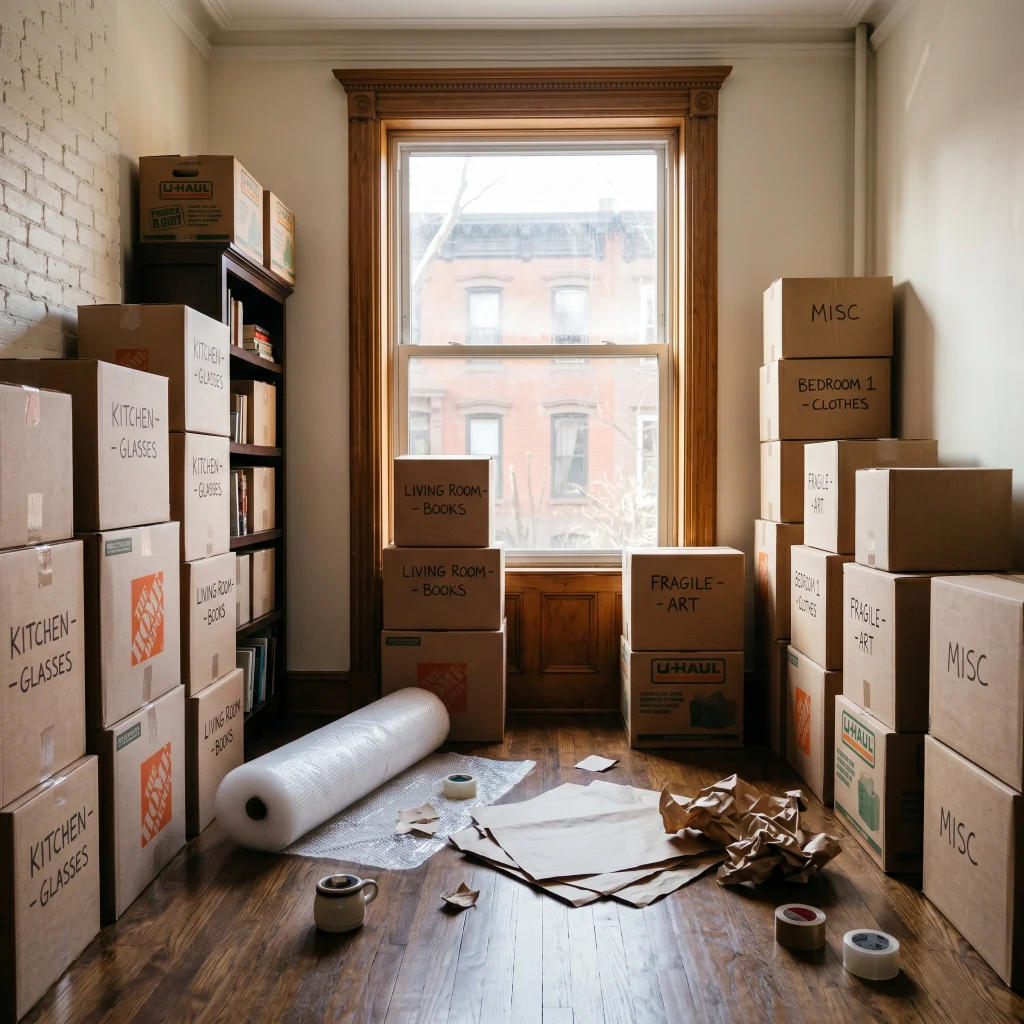
Quality Control Before the Truck Is Loaded
Self-Packing Final Check
- Every box is closed and structurally sound.
- Heavy boxes are small enough to carry safely.
- Fragile items cannot shift inside cartons.
- Liquids and prohibited items have been separated.
- Boxes are labeled by destination room.
- Priority/first-night boxes are obvious.
- Valuables and personal essentials are outside the shipment.
- Large loose items have been discussed with the mover.
- Nothing important remains hidden in cabinets, storage cages, or utility closets.
Packing for a Building With a Hard Elevator Window
Strict building windows change the packing standard because the crew cannot use the first hour of the reservation to finish basic preparation. If the freight elevator is available only for a limited block, everything that is not part of the professional packing scope should already be boxed, closed, labeled, and ready to move before the crew starts loading.
Keep hallways and the route to the service elevator clear. Do not stack boxes in a way that blocks doors, sprinklers, or the crew’s carrying path. Large items that need disassembly should be identified in advance so the mover can build that work into the arrival plan.
If professional packing is scheduled on the same day, make sure the quoted schedule leaves realistic time for both packing and transport inside the building’s rules. When that is too tight, a separate packing day can protect the move window and reduce pressure on everyone involved.
The goal is simple: when the elevator becomes available, the move should be ready to move.
Self-Packed Boxes Can Affect a Damage Claim on an Interstate Move
Saving money by packing your own cartons is completely legitimate, but it changes the evidence if something inside the box is damaged. FMCSA specifically warns interstate customers that when they pack their own boxes, it can be more difficult to establish a claim against the mover for damage to the contents.
That does not mean every self-packed box has no protection. It means packing quality, external box damage, inventory, and proof of condition become more important. If an item is fragile or expensive enough that you would struggle to prove how it was packed, professional packing may reduce both handling risk and claim ambiguity.
Hazardous and Dangerous Materials Need an Explicit No-Pack Decision
Do not treat the prohibited-items list as a small footnote. Interstate household-goods rules specifically address dangerous and hazardous materials, and a customer can reduce the mover’s liability by placing prohibited material in the shipment without the mover’s knowledge.
Ask for the mover’s current prohibited-items list. Common household categories that require attention can include fuel, flammable products, certain chemicals, pressurized containers, explosives, and other hazardous materials. Dispose of or transport them through an appropriate legal method rather than hiding them in a carton.
Mattresses, Rugs, Lamps, and Other Awkward Items Need Their Own Materials
Some objects are not fragile in the traditional sense but still pack badly in generic boxes.
- Mattresses: use a clean protective cover or appropriate mattress carton/bag so fabric does not contact floors or truck surfaces.
- Rugs: clean and dry before rolling; ask how large or valuable rugs should be protected.
- Lamps: separate shades, bulbs, and fragile decorative parts rather than moving the lamp as one loose object.
- Televisions: use a suitable television carton or equivalent rigid protection, especially for larger screens.
- Hanging clothing: wardrobe cartons can reduce folding and make closet-to-closet transfer faster.
Unpacking Includes Packaging Removal Only If the Scope Says So
FMCSA’s household-goods glossary defines unpacking as removing goods from boxes or crates and disposing of those containers and packing materials. In practice, moving companies use the word differently, so confirm what your unpacking service includes.
Some customers want boxes opened and debris removed. Others want dishes placed in cabinets, closets organized, or furniture fully styled. Those are different labor scopes and should not be assumed from the word “unpacking.”
Condition Photos Help With Fragile and High-Value Packing
Photograph high-value or fragile items before they are packed and again if damage is discovered after delivery. For interstate shipments, FMCSA explicitly recommends pre- and post-move photographs as useful support for loss or damage claims.
Keep the images yourself rather than relying only on the mover’s system.
Plastic Totes vs Cardboard Boxes: Ask the Mover Before Standardizing the Whole Move
Rigid reusable totes can work well for some household categories, especially when they close securely, stack consistently, and stay within a safe lifting weight. They are not automatically better than cartons for every item.
Cardboard moving boxes are easier to size by category, absorb less vehicle space when empty, and can use purpose-built formats for dishes, wardrobes, pictures, mirrors, and televisions. Plastic totes resist moisture better and can be convenient for repeated moves or storage, but smooth surfaces, tapered shapes, broken lids, and overfilled weight can make stacking or carrying less predictable.
Before packing the whole home in totes, ask the moving company whether it accepts them, whether there are size or weight limits, and which fragile categories should still use specialty cartons or professional packing.
Whatever container you choose, the same rule applies: it must close securely, protect the contents, stack safely, and remain reasonable for a crew to carry through the actual building route.
Frequently Asked Questions About Packing Services
Is professional packing worth it for an NYC move?
It can be when time, fragile items, physical limitations, or a tight moving schedule are the main problem. If you have enough time and your belongings are straightforward, self-packing can be more economical.
What is the difference between full, partial, and fragile-only packing?
Full packing covers nearly the whole agreed household scope. Partial packing splits the work between you and the crew. Fragile-only packing focuses professional labor and materials on breakables or high-risk items while you pack routine belongings.
Should I empty dresser drawers before movers arrive?
Ask the mover. The answer depends on the furniture, drawer contents, weight, access path, and the company’s handling policy. Heavy or fragile drawer contents often need to be removed even if some light clothing can remain.
What should I never let the packing crew pack?
Keep identification, medication, essential documents, keys, payment items, valuables you prefer to carry personally, and first-night necessities with you. Also ask the mover for its prohibited-items list before packing.
How early should professional packing happen?
It depends on the size of the home and whether you need access to packed items. Many customers benefit from packing one or more days before the move so moving day is focused on transport rather than box creation.
Can I hire packers only for fragile items?
Yes, many moving companies, including Serenity, offer fragile-only or partial packing. This can be useful when you are comfortable packing clothing and books but want professional help with kitchens, art, glass, electronics, or other breakables.
Choose the Packing Boundary That Fits Your Move
If you have several weeks, manageable belongings, and a good labeling system, self-packing is usually realistic. If one room or category creates most of the anxiety, partial or fragile-only help can solve the problem without turning the move into a full-service package.
Full packing becomes more valuable when the household cannot absorb the labor, the move window is tight, or the move includes enough fragile and complex items that unfinished packing would threaten the schedule. Place that choice back inside the full NYC residential moving plan.
Hand Off Only the Packing Work You Want to Hand Off
Serenity offers full, partial, and fragile-only packing. Choose the level based on the work you actually want to hand off.
Sources and Verification
- Serenity Movers, Packing Services: https://serenitymovers.com/services/packing-services/
- Serenity Movers, Delicate Items: https://serenitymovers.com/services/delicate-items/
- Serenity Movers, Storage Solutions: https://serenitymovers.com/services/storage-solutions/
- FMCSA, Consumer Rights and Responsibilities for Interstate Moves: https://www.fmcsa.dot.gov/protect-your-move/consumer-rights
- FMCSA, Liability & Protection: Interstate valuation, self-packed boxes and claims
- FMCSA, Household Goods Glossary: PBO and unpacking definitions
- Movd NYC, Packing Services NYC 2026 market ranges: https://www.movd.nyc/packing-services-nyc
- Big Apple Moving, NYC packing-service cost ranges: https://bigapplemoving.com/services/additional/packing/
